December 3, 2011

Lego Continuously Variable Transmission CVT

If you don't understand how the CVT (continuously variable transmission) works at this previous post...

 This creation from Nico71 can explain it perfectly! Just watch the video, all explanation inside!


As he wrote on the video description:
"Based on modified version of Zblj's Transmission. This CVT enables a variation of the speed (and the torque) from 40rpm to 200 (1/5, 1/1) with constant speed for the motor (200rpm). The two mechanical tachometers show respectively the speed of the motor and the speed of the output."

And the rotation of the yellow connector shows when the torque limiter slides.

By the way since the previous CVT post I've found two more examples of cvt gearboxes:

The firs one is made by Sheepo  that uses two conical surfaces concted with a wheel, as some motorcycles do.


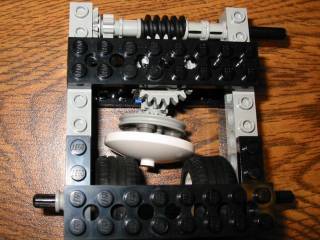
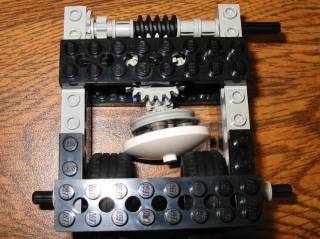
The other cvt gearbox is a compact and very smart idea by Rob Stehlik at Robs Lego Design site

"My Lego CVT is a friction drive assembly, and it is really just a quick concept that wouldn't be very practical in real applications."

"These pictures show the full range of the white disk. One of the wheels is the input, and the other is the output. The speed of the output can vary from much slower than the input speed to much faster. Sounds real technical doesn't it? I didn't bother calculating the exact ratios."


December 2, 2011

Sheepo is the winner!

At http://technic.lego.com is announced the AFOL winner of the "2011 TAKE THE CHALLENGE" and as expected is....

SHEEPO!! my congratulations your creation deserves it!


GBC Unloading train module

Nice example of unloading module that manages to receive lots of balls form a train module and give them at approximately one per second, as GBC rules said.

Creation by Brdavis


November 30, 2011

A truck driver`s dream

A Lego truck turns into a sports car. Inspired by the '80s movie "Condorman"

Lovely transforming tuck in brick style, combined with Power Functions ;-) by 3okapis (youtube channel)

Lego Oldham coupling and Schmidt coupling

"The Oldham coupling and Schmidt coupling are two various mechanical solutions for transmitting drive between two parallel axles that are not aligned in line".


As wroted on Sariel's Webpage: ( Visit for full explanation, instructions, more information and Moc's)

That makes this two mechanisms an alternative to universal joints, which are long, and to gear wheels, which only fit in specific spacings and affect power/speed ratio if not meshed at 1:1 ratio.

The Oldham coupling consists of two identical rotors, each connected to one axle, and a sliding element between them. In short, the Oldham coupling is short and maintains 1:1 ration, but is complex, fragile and has large diameter.

The Schmidt coupling consists of three discs or triangles connected with links, it can work while its input and output are moving relatively to each other. That makes it an interesting solution for transferring drive to the moving elements of your construction. The Schmidt coupling is also extremely robust and can handle high torque while generating minimum backlash.


A "real" Schmidt coupling, as you can see the Lego Technic version works perfectly...